

Weekend is here. Chores. Errands. Family time. Friends. And content.
That last one scares me a little. Not in a bad way. And not literally. But I don’t know what I’m going to end up watching.
Reels and shorts waiting at the bottom of my screen. Netflix. Prime. Disney. News.
A friend recommended a beautiful foreign-language series. I don’t have the patience for subtitles right now. Started a movie. Lost interest in minutes. Seasons and episodes used to excite me. Now they feel like commitment.
Is it exhaustion. Is it fatigue. Is it just me.
The world’s best content is one tap away. And somehow I still don’t know what to watch.
Three weeks ago I wrote Who Schedules the Moment. The argument was that the programming job, the one the TV editor used to do, the one the radio DJ used to do, the one the newspaper editor used to do, got handed to the user. Every swipe on Instagram is a scheduling decision. Hundreds of them per session.
That was the diagnosis for one feed.
Tsunami of content is a bigger problem than that.
Let me show you what is happening, because you have probably been feeling it without naming it.
Inside one feed, the problem is already hard. The feed regenerates faster than you can choose. The algorithm presents the menu, you make hundreds of half-second decisions, the menu keeps coming. Television used to have three channels, then thirty, then three hundred. Each was a closed set. You could finish the menu. The feed is not a closed set.
I wish I had to worry about just one feed.
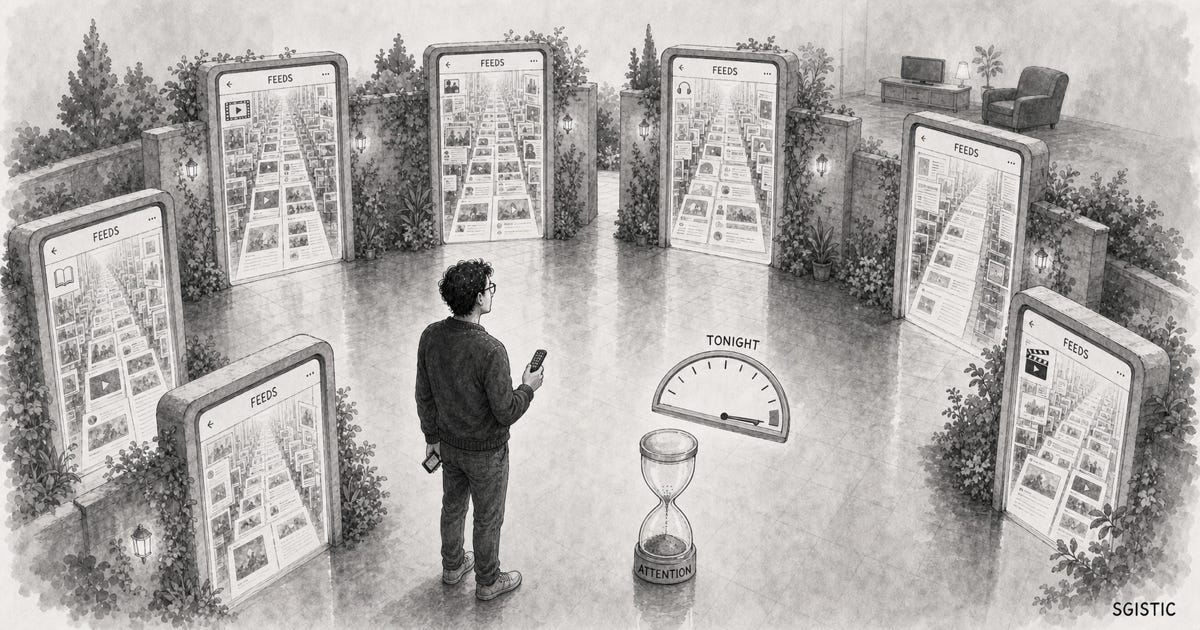
Actually it feels like standing between seven different infinities.
Instagram is one infinity. Netflix is another, with its own catalog and its own algorithm. Prime is a third. Disney a fourth. YouTube a fifth. Substack a sixth. WhatsApp forwards a seventh. Each one is a separate walled garden. Each one infinite inside. Each one pretending it is the whole world.
The thing your friend recommended lives in one walled garden. The movie lives in another. The Substack you saved lives in a third. The Reel that almost made it lives in a fourth. You cannot see them in one place. There is no master menu. There is no single inbox.
So you are not just the scheduler of one feed. You are the meta-scheduler choosing which infinite feed to enter tonight. And once you enter, you become the scheduler of that one too.
Two failures stacked on the same human. Across-platform paralysis at the top. Within-platform paralysis once you commit. Either one alone would be hard. Both together is what a content nightmare feels like.
This is attention recession.
The supply of content has exploded. AI made the cost of making things go to near zero. Anyone can produce video, text, audio, music, code in minutes. The number of pieces of content being made is doubling, then doubling again.
Time has not exploded. Humans have seven, maybe eight hours of screen time in a day. That number cannot keep growing. There is sleep. There is work. There is a body.
Same denominator. Exploding numerator. Average attention per piece collapses. Call it attention recession. Not a crash. A sustained contraction where the old assumptions stop holding.
Even the good things now arrive into exhausted attention. Whether anyone notices is no longer a function of quality.
This is the strange part.
I came to write this post with a plan. The first piece in a new category. Sit down, write attention recession, file it, move on.
I could not sit down.
I was distracted by the same problem the post is about. I scrolled while writing. I opened tabs to check whether I had read a thing I half-remembered. I lost twenty minutes to a Reel I did not choose.
I did not have time to think about not having time to think.
That is the recession at full force. Even noticing it takes attention you no longer have.
This post is the first in a category I am calling AI Reallocation.
The frame is simple. AI did not destroy value. It moved it. When the cost of making goes to zero, every old assumption about where value lives gets re-priced. Attention is the first thing to get reallocated. Money, trust, permanence come next, in posts I have not written yet.
If you have been feeling something shift and have not had words for it, this category is the attempt to give you some.
I went back to Michael Scott because choosing it doesn’t demand my attention.
Unlike the feeds. Or the platforms.
I just wish there was an easy way to find something that nice.
About SG
I run Dobby Ads, an AI Creative Agency. I tend to overthink. This is where that overthinking goes. Connect with me on LinkedIn.