

Days and weeks since I wrote about the new face of discovery. Still bothers me, like a hunt. I keep going back to AI to push it, and logging my observations as we chase.
It is 2026. ChatGPT came eons ago. Discovery is still where it was.
Researchers across the world must be solving this. It’s too central not to be. And it is not an easy problem, else we would have seen the solution by now.
Or, what if the solution is already at play and we don’t feel it? What if they’re already close to unveiling it?
If they are close, what would they be looking at? What would I be missing?
The Discovery Job
So I went back to my own post and started reading it like a critic.
Here’s the line that didn’t sit right:
“The labor moved. It never disappeared. It just got disguised.”
That’s almost true. It’s also not quite right.
Search’s path is clean.
Library → encyclopedia → Yahoo directory → Google links → Google Instant → ChatGPT
Each step removed effort. The user did less, the system did more. Always less. Until the user did almost nothing.
Discovery’s path doesn’t move in one direction.
Town crier: show up at the square, listen. Almost no labor.
Newspaper: buy it, skim sections. Some labor.
Radio, TV: sit down. The programmer scheduled. You watched. Less labor than the newspaper.
Cable, TiVo: more channels, recordable. More labor.
Facebook, Instagram: open the app, see your friends’ posts.
TikTok, Reels: open, swipe, judge, swipe, judge, swipe. Hundreds of half-second decisions per session.
Look at that curve.
Discovery’s labor went down, then back up. We didn’t notice because the new version was disguised as leisure.
That’s what I missed.
Discovery had its own arc. It just went the wrong way after we got phones.
The labor went up. That’s the observation. The question is why.
Town crier - the crier picked. Newspaper - the editor picked. Radio, TV - the programmer picked. The 8pm slot was thirty minutes long because someone decided it was thirty minutes long.
Cable came. The programming responsibility started slipping. TiVo finished the slip. Then social media arrived and the slip became a transfer.
Every swipe on TikTok is a programming decision. Pick this video, skip that one, watch the next, drop out at the first second of one that doesn’t grab you. The algorithm presents the menu. You schedule.
That’s the quiet move that broke discovery. Not “the algorithm took over.” The algorithm built the menu. You’re the one running the show.
The job didn’t disappear. It got handed to you.
Don’t Regret Per Minute
I almost published a piece. I didn’t.
The piece was called “Don’t Regret Per Minute.” The argument: TikTok optimizes for “don’t let go” - keep you watching. The new metric should be “don’t regret” - did each minute feel worth it. The architecture: optimize transitions between videos, not individual videos, so each one lands harder than it would alone.
I cooked that idea with AI for days. It felt right. It survived round after round of pressure-testing. I was three small edits from publishing it.
Then I ran the failure-mode test from a piece I wrote recently - “Refusing the shallow version.” Pattern-matching dressed as competence. Closure-seeking under uncertainty. Fake synthesis. Premature commitment dressed as progress. Exit move dressed as helpfulness.
The piece failed three of them.
“Don’t Regret Per Minute” was also prescriptive. It told the user how their session should feel. That’s eat-your-vegetables in a clever costume. A metric that judges the user is a different object from a product spec that describes the system. I had collapsed the two.
The transition-optimization architecture had a manipulation problem at its center. A system that learns “sad video then funny video makes the funny one hit harder” will start engineering the sad video on purpose. That’s just TikTok with better tricks. I’d marked the problem as unresolved and moved on. That’s premature commitment.
And the article tied it all up with two confident lines about who builds the next era. That was the exit move - closure-shaped, so the piece felt done.
I killed the piece.
What survived the chase isn’t a metric. It’s older than that.
The Product Specs
Some things came through every round of pressure-testing.
The product can’t make money by keeping you longer. The moment monetization depends on time-spent, the system drifts back to addiction. That was the original sin of the feed era. Whatever comes next has to monetize differently - fewer impressions worth more, or subscription, or something I haven’t seen yet.
The product is video. Reading takes effort. Audio is passive but slow. Video is the native format of discovery in 2026. That’s not a preference, it’s where attention has consolidated.
The product is free at the edge. Discovery has always been free at the moment of consumption - you didn’t pay the crier, you didn’t pay to turn on the radio, you don’t pay to open Instagram. Money came from somewhere else. Whatever’s next has to honor that.
The product runs on comprehension, not behavior. This is the part of the original post that still holds. Watch time and clicks are proxies. AI that watches video, listens to audio, reads text, and actually understands what’s there - that’s the unlock. Without it, none of this works.
The product is anchored to specific entities you care about. People, places, ideas, builders. The interest graph isn’t broken - platforms weaponized it, but the underlying signal is real.
The product is fresh. Discovery isn’t an archive. Yesterday’s was yesterday’s. Whatever comes next has a recency pulse.
The product is interstitial. It fits in the cracks between other things, the way a newspaper used to. It doesn’t demand its own time slot. You step in, you step out, the world keeps moving.
These don’t tell me what the product is. They tell me what it can’t violate.
So?
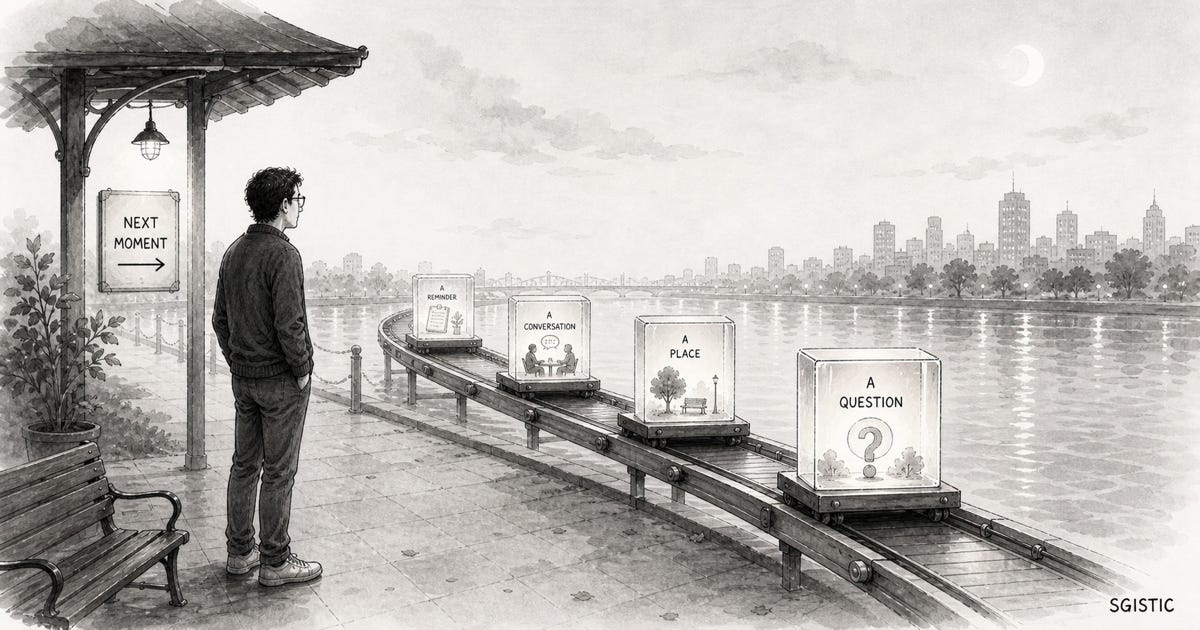
What I think is real: someone or something has to start scheduling the moment again. That’s the question. Not “what’s the next feed.” Not “what app replaces Instagram.” But who or what takes the programming job back from the user?
Candidates I keep turning over.
The system itself - comprehending content and your state well enough to deliver a finished thing.
A creator - scheduling for their followers in real time, the way a radio DJ used to.
A small group - the group chat as the new feed, friends scheduling for each other.
A time - daily drop, weekly drop, ends when it ends.
An event in your life - you finished dinner, the system knows, the moment begins.
None of these are answers. They are shapes the question can take.
That’s where I am in April 2026.
The constraints I trust. The diagnosis I trust. The metric I almost committed to, and didn’t. The question still open. Or maybe it is closed, and we haven’t realized it yet.
If you’ve seen further on this, I’d like to hear from you.
About SG
I run Dobby Ads, an AI Creative Agency. I tend to overthink. This is where that overthinking goes. Connect with me on LinkedIn.