

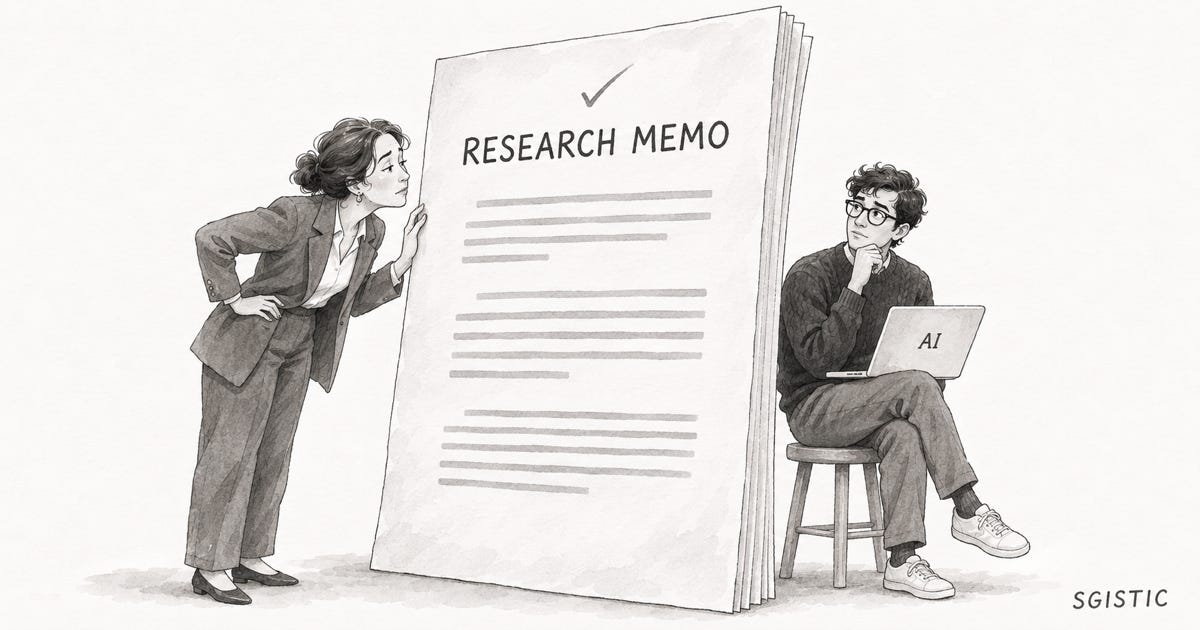
A junior lawyer submits an excellent research memo. AI helped write it. The partner can still evaluate the memo. What she can no longer easily evaluate, from the memo alone, is the junior.
Did the junior understand the arguments, test the assumptions, spot the weaknesses? Or did the AI do most of that?
I’ve been circling this since April, when I wrote about the Thinking Trail, a way to make the reasoning behind AI-assisted work visible. A paper we recently reviewed at HAIC Lab pushed me toward a related question: what happens to critical thinking when AI does more of the work?
I now think both are parts of a larger problem. For decades, professional work did three jobs at once. It produced something useful. It taught the person doing it. And it gave others evidence of that person’s ability.
AI is beginning to pull those three apart.
1. You need expertise to question AI
Hao-Ping (Hank) Lee and colleagues surveyed 319 knowledge workers and collected 936 examples of generative AI use at work. Greater confidence in AI was associated with less reported critical thinking; greater confidence in one’s own ability, with more. This is self-reported behavior, not measured ability, so it doesn’t show AI is making anyone a worse thinker.
The key finding: some participants couldn’t spot errors or improve AI output because they lacked the domain expertise to do so.
An experienced engineer knows which architectural assumption won’t survive production. A lawyer notices the missing precedent. A physician sees the symptom that doesn’t fit. Someone without that knowledge reads the same response and finds nothing wrong.
We talk about critical thinking as a general skill. But knowing which assumption to challenge depends on what you know.
The paper also found that AI shifts where thinking goes: from gathering information to verifying it, from building solutions to integrating proposed ones, from doing tasks to overseeing them. The authors call part of this task stewardship.
That sounds like a sensible division of labor. AI executes, people judge. But if judgment depends on domain expertise, where do beginners get that expertise once AI does the tasks they used to learn from? The authors raise the same worry.
It isn’t a new problem.
2. Automation has been disrupting learning for decades
In 1983, Lisanne Bainbridge described the Ironies of Automation. Machines take over routine operation and leave humans to handle the failures. But handling failures takes knowledge built by operating the system, and automation removes the chance to build it.
Matt Beane found a version of this in robotic surgery. In Shadow Learning, he showed that the robot made trainees optional. The old progression, where juniors took on more under supervision, broke down. The few who became competent did it largely outside approved training.
Technology can improve how work gets done without improving how people learn to do it. Generative AI is bringing that problem to most knowledge professions at once.
Go back to the memo. The junior used to search for cases, read judgments, misread arguments, correct them, and gradually learn what mattered. A senior reviewed the work and discussed the reasoning. The firm got a memo, the junior got experience, the senior got a view of the junior.
Now AI produces a strong first draft. The firm still gets its memo. But the junior may skip the investigation, and the senior has less evidence of how the junior thinks.
Those are two separate losses. One is about how expertise develops. The other is about how we recognize it.
The second is what led me to the Thinking Trail.
3. The Thinking Trail, and why I no longer fully trust it
Earlier this year a client questioned the thinking behind work we’d delivered. We had put real effort into the analysis, but the output didn’t show it. It could just as easily have been assembled in an afternoon with AI. I couldn’t blame him.
So I proposed a practitioner standard: a short trail documenting the context and constraints used, alternatives rejected, underlying assumptions, points where the reasoning was challenged, and confidence and known gaps.
The weakness was one I built in myself.
I suggested asking AI to draft the first version of the trail from the conversation. That makes a trail easy to create. It also makes a convincing but misleading one easy to create.
A few days later I wrote I Wish My AI Could Talk to Your AI: what if the system captured the trail automatically, as the work happened? I argued that someone genuinely engaging with a problem would leave a visibly different trace from someone assembling an answer.
I’m less sure now. Someone who challenges an AI ten times isn’t necessarily a better thinker than someone who sees the right answer at once.
Much of the thinking happens off the screen.
And a system that records every false start could become a permanent file on someone’s uncertainty. Would people explore hard ideas as freely if every dead end could be scored by their employer?
Dorine Coffin and Lance Odegard at Thomson Reuters describe AI turning junior lawyers from originators of reasoning into editors of reasoning the AI supplied. Their remedy is a conversation, not a document. The senior asks the junior to walk through how they got there, then pushes on it. That’s harder to fake than a written trail. It also costs senior time.
Trails still help make important decisions reviewable, and they give mentors something concrete to discuss. But a trail can’t show that someone learned, or that they’ll decide better next time. For that, we have to look at learning itself.
4. Better work, but better workers?
A 2025 PNAS study gave nearly a thousand high school math students AI tutors. Those with unrestricted access did better on practice problems. Once the AI was taken away, they scored 17% lower than students who had never used it. A second group used a tutor built to guide rather than answer. They avoided the harm but didn’t beat the control group. The guardrails prevented damage; they didn’t show that AI produced better learning. And students didn’t necessarily notice. They felt they were doing well while becoming less able to work alone.
School math isn’t professional work. The professional version arrived in September 2026.
David Autor and colleagues ran a three-month randomized trial of an AI drafting assistant with 133 patent lawyers at eleven US firms, 91 of whom completed the full protocol. Google funded and helped run the study, and several of the authors work there. It remains a working paper.
AI improved drafting quality, most of all for juniors. At the end, everyone reviewed a flawed patent application without AI. Seniors who had used AI beat senior controls. Juniors who had used AI showed no average advantage. Their scores spread out, with fewer middling results and more at both ends. The authors suggest AI helped some juniors learn and let others skip the learning. The junior sample is small, so that pattern needs caution.
The headline holds regardless. The lawyers who gained most from AI in drafting gained least in independent judgment. The authors conclude that foundational expertise may be a prerequisite for building durable skill through AI-assisted practice.
That’s the critical-thinking paper again, now with experimental evidence.
People who already know a domain can learn from AI because they can see what’s missing.
Beginners can get enormous help without acquiring the judgment.
AI doesn’t have to undermine learning, though. In a 2025 study in the Quarterly Journal of Economics of 5,172 customer-support agents, Erik Brynjolfsson, Danielle Li and Lindsey Raymond found the largest productivity gains among less experienced workers, along with evidence that they learned: the gains persisted even during AI outages.
How AI is introduced, the kind of work, and the feedback available all matter. The useful question is how to design work so that using AI also builds the capability beginners will need later.
5. Apprenticeship needs deliberate design
Traditional apprenticeship was never as good as nostalgia suggests. Some juniors got excellent mentors. Others spent years on repetitive work and learned little.
Aviation and medicine have long used structured training alongside real-world experience. Pilots rehearse emergencies in simulators. Residents take on responsibility under structured supervision. There’s no reason other professions should keep relying on whatever routine assignments happen to teach.
AI makes the alternatives cheaper. Give a junior engineer twenty simulated production incidents. A lawyer a run of difficult cases. A new manager a set of hard conversations with consequences and feedback. Let them attempt, decide, and explain. Give them AI too, but design the exercise around what they need to learn.
Some firms are trying. In October 2026, Pillsbury adopted rubi, a virtual apprenticeship platform with simulated transactional work and an AI mentor, after piloting it with first-year associates. The announcement shows willingness to experiment, not evidence of better lawyers. McKinsey has described an answer-key model: juniors attempt the work alone, compare it with AI’s version, then discuss the gap with a manager. Whether the gap narrows over time becomes something you can track.
This is where three ideas need keeping apart.
A Thinking Trail shows how someone approached a task.
Apprenticeship gives them practice and feedback.
Assessment establishes whether they actually improved.
You can use all three. None substitutes for the others.
And assessment can’t mean asking one AI to grade another’s answers. It needs credible standards, unfamiliar problems, and evidence that performance transfers. For some roles, unaided performance is the point. For others, the better test is how well someone works with AI, including whether they catch deliberately planted errors. The job should decide the test.
6. Who pays?
Juniors used to pay for their training partly through useful work. AI devalues that work.
Luis Garicano and Luis Rayo have modeled this. As AI does more junior work, what apprentices can offer in exchange for training shrinks. But collapse isn’t inevitable. It depends on how much more an AI-equipped expert produces than AI alone. If the gap is large, firms keep training. If it’s small, the incentive fades.
The savings from automation are immediate.
The returns from training arrive years later, if the person stays.
Add the older problem that trained people leave, and the firm that pays for training doesn’t capture all of the benefit.
The evidence on what employers will do is mixed. In a survey McKinsey cites, executives expecting AI to increase entry-level hiring outnumbered those expecting a decrease by almost three to one, yet a third of employers said AI had already removed foundational tasks juniors learn from. Bank of America kept its intake near 4,000 interns and campus hires in 2026 while redesigning those roles around AI. Firms are making different bets on the value of future professionals.
The same goes for simulation and assessment. Wanting a credible signal of readiness and paying for one are different things. It has to predict something employers value: fewer mistakes, faster progression, less supervision. Otherwise it’s another certificate.
All of this assumes the expertise we’re trying to build will stay valuable.
7. How do we know an expert is better?
In June I wrote about the Reality Gradient: AI is easiest to rely on when reality quickly tells you it’s wrong. Code runs or fails in seconds. An acquisition, a litigation strategy or a senior hire may take years to judge, and even then the result is tangled up with luck, markets and execution.
I argued then that AI cut the cost of producing work without cutting the time needed to verify it. There’s another side to that. Slow, ambiguous feedback doesn’t just make AI hard to evaluate. It makes human expertise hard to develop and measure.
In 2009, Daniel Kahneman and Gary Klein, from opposing traditions of research on expert judgment, published Conditions for Intuitive Expertise: A Failure to Disagree. Their common ground: reliable intuition needs an environment with learnable patterns and enough feedback to learn them.
Confidence and years of experience alone are not evidence of accuracy.
A CEO might make five acquisitions in a career. A lawyer may never learn whether the strategy she rejected would have won. Twenty years of experience isn’t twenty years of useful feedback.
That doesn’t mean experienced professionals lack expertise. It means that where outcomes are slow and noisy, we measure expertise less well than we think. Clients pay for a mix of judgment, reputation, trust and accountability. Accountability matters; someone has to own the decision. But owning a decision doesn’t make it more accurate.
AI faces the same problem. It can see more examples than any one professional, but humans could always study past decisions too. More examples don’t identify causes or reveal what would have happened otherwise. AI may still gain an edge through consistency and broader comparison. Whether that becomes better judgment will depend on the domain and the evidence.
Even if it does, we may struggle to recognize it. In some domains, neither a confident senior professional nor a confident AI can offer decisive evidence that a recommendation is right.
We have long treated experience as evidence of expertise. Often it is. But the strength of that evidence depends on how much the person has been able to learn from reality. AI is forcing us to examine an assumption that predates AI itself.
In some professions, AI might become better than the experts before anyone can prove it.
~*~