

A client sent me a video last month.
A perfume bottle, slowly rotating, suspended in what looked like liquid smoke. The light caught the glass at exactly the angle where you stop thinking about a bottle and start thinking about a feeling. Forty-three seconds long. No words. The kind of video you watch twice without realizing.
“SG, see this. Make something like this for us.”
I have heard that before. Many times. Many clients.
Later, my team looked for who made it.
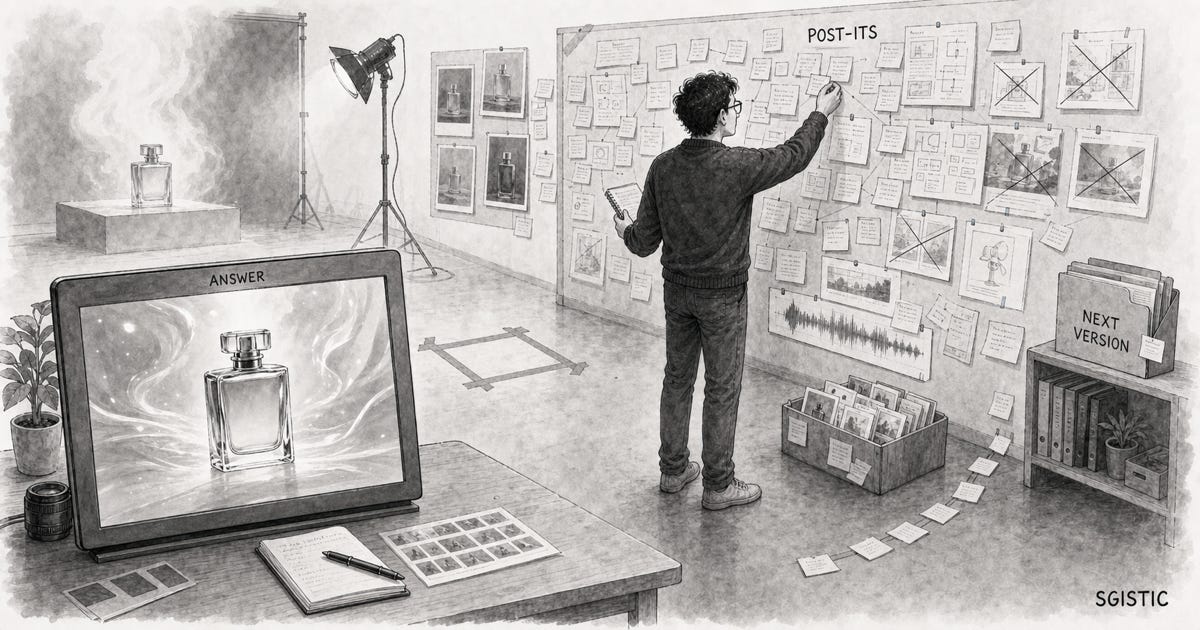
A studio in New York. Six people credited. A creative director who’d done this kind of work for fourteen years. The making-of, which they’d posted as a flex, ran longer than the film itself - eleven minutes of BTS for forty-three seconds of finished work. And even that was the polished version. You could see the wall of references that didn’t get used. The bottle on the floor with tape marks around where it stood for the lighting test. The whiteboard with crossed-out words. The director on a stool, eyes closed, listening to a sound designer try the fourth version of the ambient track.
My client had watched the forty-three seconds. They had not watched the eleven minutes. They especially had not watched the weeks that came before the eleven minutes. The post-its on a wall in New York. The brand brief that got rewritten three times. The argument about whether the bottle should rotate clockwise or anti-clockwise, which mattered for reasons they could probably no longer explain. The rejected mood board that someone is probably still annoyed about.
What the client saw was the answer. What they asked for was the answer. What they were paying for was the answer.
The work that produced the answer was invisible to them.
And the strange thing is, it’s invisible to most of us, most of the time, with almost everything we look at.
Pick up a Starbucks cup. The lid is doing five things at once. It keeps the heat in. It tells you which side to drink from without you having to think about it. It lets you stack twelve of these in a delivery bag without the tower collapsing. The hole is positioned where a hand naturally tilts the cup, not where the cup would naturally pour. Someone fought for that hole. Someone tried it three millimeters to the left and rejected it. Someone almost made the cup square.
A Mercedes seat. The stitching catches light a particular way when the door opens at night, and someone decided that. The leather ages differently in Phoenix than in Stuttgart, and someone tested that. The angle your lower back makes at the eighth hour of a drive is not the angle it makes at the first hour, and someone measured that. Every seam you don’t notice is a seam that lost a fight against another seam you would have noticed.
The cup is the answer. The seat is the answer. The post-its disappear.
This is the problem most agencies run into and never name. The client sees the artifact. The client asks for the artifact. The client pays for the artifact. And the work that produced the artifact - the part that actually makes the next one possible - is treated as overhead. As preamble. As what you do before the real work starts.
But the artifact is the residue.
The work is the substance.
So here is what we do on projects like that perfume bottle. Not as a methodology. Just as a habit.
We watch the video on mute. Then we watch it without watching it - just listening. Then we watch it one frame at a time, asking what choice each frame was the result of. The smoke wasn’t smoke, it was glycerin under a specific kind of side-light. The rotation wasn’t constant, it slowed by a fraction at the moment the label became readable. The fade to black at the end took six frames. Each of these was a decision. Each decision had alternatives that were tried and rejected. We couldn’t see the alternatives, but we could see that they must have existed, because every choice in a good film is a choice against something.
Then we ask the bigger questions. Why a bottle, not a face. Why smoke, not water. Why forty-three seconds, not thirty, not sixty. Why no words. Why this music, this pacing, this particular shade of off-white in the background that probably has a Pantone number someone in New York knows by heart.
We don’t get all the answers. We get enough to understand that the video our client loved was sitting on top of two stacked things. Underneath was the brand - forty years of someone deciding what a bottle of theirs means, what it doesn’t mean, what it should make a stranger feel in three seconds. On top of that was the studio in New York - fourteen years of learning how to render meanings of that weight on film. The video the client sent us was the surface of that stack. The brand had its position. The studio had its position. The film was where the two met.
You cannot borrow a position. You can only earn one. And the film our client loved was sitting on two of them.
What you can do is start capturing the journey, the post-its if you will. Not as a deliverable. Not for the client. For yourself. The wall of references. The brief that got rewritten. The version that didn’t ship. The reason it didn’t ship. The moment someone said the obvious thing that unlocked everything else. The version that almost shipped but didn’t because of one small thing that you only saw on the fourth viewing.
Most of this work disappears the day the project ships. The video gets posted, the invoice gets sent, and the desk gets cleared for the next one. Six months later when a different client asks for “something like this,” you have the finished video to show them and almost nothing of the process that produced it. You can’t even retrace your own steps. You become the client on your own work - looking at the answer without the post-its.
The agencies that compound are the ones that keep both. The answer and the journey. The artifact and what it cost to be that way.
On the perfume project, we made the video. It was good. It wasn’t the New York video, because we are not New York, and pretending to be would have been a lie the client could see. It was a Dobby video, made by a smaller team in less time with less money, but made deliberately - every choice understood, every alternative considered, every reason recorded. When the client comes back two months later for the next one, we won’t start from zero. We will start from the wall.
The next time someone sends you a piece of work and says “make something like this” - pause before you say yes. Watch the artifact. Then go looking for the post-its. They are not in the video. They are in what was crossed out, what was tried and abandoned, what almost happened and didn’t. That is the actual deliverable hiding inside the deliverable.
Most people will never see the post-its. That’s fine.
The post-its are not for them.
They are for the next version.
About SG
I run Dobby Ads, an AI Creative Agency. I tend to overthink. This is where that overthinking goes. Connect with me on LinkedIn.