

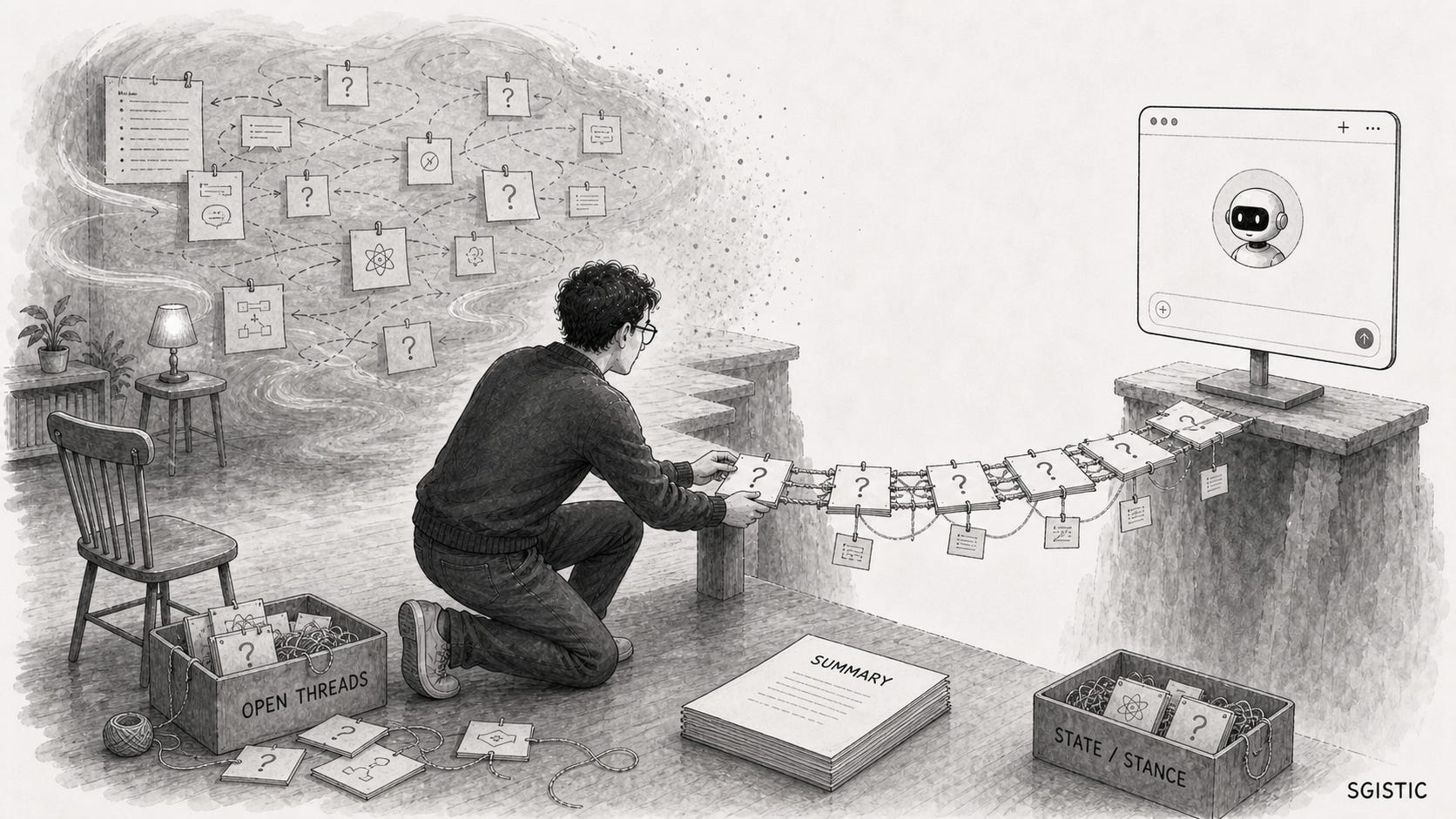
After I published the Interruptive Thinking paper, I wanted to keep going.
The paper had landed. The ideas were out. But the conversation that produced it - the long, looping one with Claude over many days, where the actual thinking happened - had open threads I hadn’t followed yet. Things the conversation had pointed toward, and we hadn’t reached. Adjacent territory, the paper didn’t cover, but the conversation had been pressing into.
So I opened a fresh thread to continue.
It didn’t work.
I tried giving the new thread a chronological summary. First, we talked about this, then this came up, then this turn shifted the frame. The new thread read it patiently. Said something polite. Started shallow.
I tried pasting the entire previous chat. Tens of thousands of words. The new thread read it. Started shallow.
I tried both. It started shallow.
I knew the ideas. I had the paper to prove it. What I had lost was harder to name. It was the state I had been in by the end of the previous conversation. The state where the next thought was almost arriving. Anjali Singh, writing about AI and human cognition, points back to Dewey: reflective thinking requires enduring a state of perplexity, confusion, or doubt prompting inquiry, and a suspension of judgment during this period of inquiry. That endured perplexity is the state. It is what gets thinking to keep going. And it is the first thing the summary throws away.
Lev Tankelevitch, in his work on what he calls the metacognitive demands of generative AI, points out that working with these tools well requires constantly tracking your own thinking - your goals, your confidence, your shifting strategies. Most of that tracking is invisible even to yourself. It almost never makes it into a summary.
Summaries kept failing because summaries are the wrong shape for what I needed. A summary captures what was said. It cannot capture where I was inside it.
A conversation is not a sequence. It is a state being held.
The turns are visible. The state is not. The state lives in the pressure points where I almost said something and pulled back. In the questions, I noted internally but did not articulate. In contradictions, we surfaced but intentionally left unresolved. In the direction we were heading when we stopped.
None of this survives the compression to bullets.
There is a second layer to this, harder to talk about. When I tried to resume, I was not just re-entering my own state. I was trying to re-create a shared zone that had existed between me and the previous Claude instance. That instance was gone.
The new instance had no overnight.
It had not been thinking about this. It could read the transcript, but it could not have been warming to it. It started cold because it could only start cold. And cold partners produce cold conversations, no matter how much context they have.
If I had been resuming with a person - a friend I think with - they would walk in still partly warm. They would have been turning it over. They would arrive with a new angle or a lingering doubt. Some of the state would be preserved in them. We would re-warm faster because at least one of us never fully cooled.
With AI, no one really stays warm. Not the AI, because it has no continuity. Not me, because I have slept and worked on other things. The only bridge is the artifact. And the artifact is summary-shaped when what I needed was state-shaped.
What eventually worked was not a better summary.
I gathered every conversation I had had on the topic. Every fragment. Every adjacent thread. I made something that was not a record of what we had discussed, but a map of where we had pressed and not finished pressing. Open questions. Live tensions. Unresolved directions. Things I almost saw. I wrote them as questions, not conclusions. The artifact was not the conversation. It was the unresolved perplexity the conversation had left in me, written down before it cooled.
That worked. Not all at once. Not perfectly. But I could re-enter.
Which makes me think the problem with summaries is not that they are bad summaries. The problem is the genre itself. A summary’s job is to compress toward resolution. To say what something was. But thinking does not live in what was.
Thinking lives in what is still open.
The summary is the artifact of a conversation that is over. To continue a conversation, you need the artifact of one that has not ended yet.
I do not have a name for that artifact. I am not sure anyone does. I know it would have to do two things at once. It would have to bring me back to the state I left - re-enterable, not just readable. And it would have to bring the AI to a starting state that is warm - not a transcript to be processed, but a live position that had not fully cooled.
State for me. Stance for it.
Both. Past that, I am still where you are.
What I am sure of is that almost everyone working with AI right now is trying to do this with summaries. The summaries keep producing shallow re-entries, and we keep blaming ourselves or the AI for not getting back to where we were.
The summary is not where we lost the thinking. The summary is the place we never built the right thing in the first place.
About SG
I run Dobby Ads, an AI Creative Agency. I tend to overthink. This is where that overthinking goes. Connect with me on LinkedIn.