

We were working on a wellness brand. I gave the system a brief. Structured, specific, the kind of document you’d hand a creative team on day one.
What came back wasn’t what I’d asked for.
The brief had been abstracted. Not summarised. Not paraphrased. Lifted into a register where it read as poetry.
A video concept came out of that pass. The team wouldn’t have reached it on their own. No person on the team was holding every constraint at once: the brand’s restraint, the rejected directions, the small operational corrections, the cinematic tension.
The system was holding all of it. The team was operating inside the system.
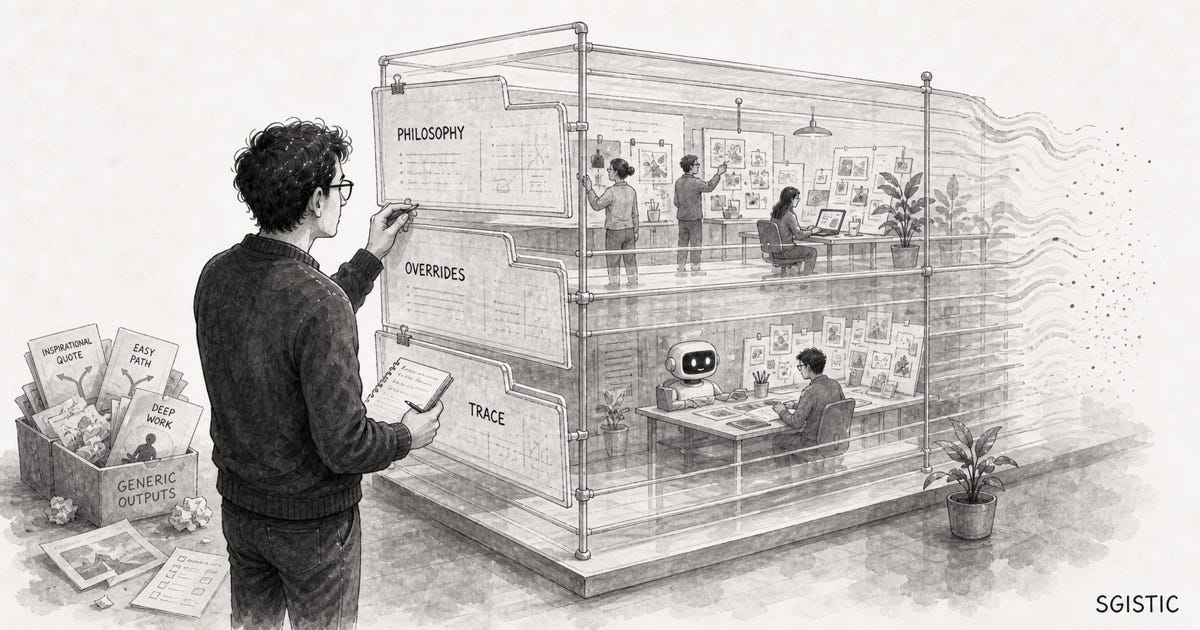
When I went back to look at what I had actually built, it wasn’t a prompt. It was a layered system.
A philosophy file for non-negotiables. A primitive that defined the smallest unit worth keeping. A seed. The smallest emotionally meaningful idea capable of holding attention. A reasoning trace that preserved operational memory across reruns. An overrides layer where corrections accumulated. Avoid jewelry. Calmer pacing. Less slow motion. The philosophy stayed stable. The overrides absorbed the team’s notes.
A rerun loop built for convergence instead of perfect first-pass generation.
Each layer existed because the system failed in a predictable way without it.
Then I noticed something else. The team started modifying outputs on their own. Small changes. Within a range nobody had written down. They’d internalised the philosophy through use, and the modified versions went back in. The emergence wasn’t magic. It was the predictable output of a structure that held.
A few weeks later I found myself doing the same thing for image generation. Different domain. Different artifacts. Themes. Stillness, endurance, cycles, growth. Archetypes that collapsed hundreds of SKUs into a handful of emotional categories. Variability controls, composition rules, disruption rules. Again, every new layer existed because the previous system broke without it. By the end, a single file could generate coherent campaigns across hundreds of SKUs while still holding the worldview of the brand.
Different domain. Different artifacts. Same operation.
The invariant isn’t the files. The invariant is the layering.
Each layer existed to solve a specific failure mode. Drift. Repetition. Incoherence. Rediscovery work. Taste collapse. The files changed with the domain. The work didn’t.
I thought I’d been managing a content project. I was doing something else.
I’d externalised my taste so the system could hold it without me in the room. The system held my taste. And once it was running, the team started holding it too, through the system.
PRDs describe behaviour to be built. These files described judgment to be applied.
How it happened became the product.
The closest analog is UX design.
UX designers translate user needs and business goals into operational artifacts. Design systems, interaction patterns, component libraries. They maintain coherence across surfaces. Without the design system, the product drifts.
A Thinking Environment Designer translates taste and domain reasoning into operational artifacts an AI can work inside. They define primitives, separate philosophy from overrides, design feedback loops, diagnose drift.
The analogy breaks in one important place. UX designers test against users. The feedback loop is external. Bad UX shows up in usability tests, support tickets, metrics.
Bad thinking environments are harder to detect. A team can operate inside a collapsing system without realising output quality is degrading, because the environment still feels coherent from inside it.
UX has dark patterns. TE will have something worse. Invisible taste collapse.
Nobody has figured out the equivalent of usability testing for thinking environments yet. That’s the kind of open problem disciplines form around.
I could use one.
For external comms, so teams could write in alignment without escalation loops. For engineering onboarding, so new hires wouldn’t have to reverse-engineer worldview from Slack history. For creative systems, so new client work wouldn’t restart from zero every campaign cycle.
I haven’t hired one because the role doesn’t properly exist yet.
But the people probably do. The UX designer who built your design system. The editorial lead who maintained voice across hundreds of pieces. A specific kind of staff PM who stabilised organisational judgment without ever being asked to.
They have a head start.
That’s usually how disciplines begin. The work appears before the title does. Someone notices they could use one. Nobody can hire one yet. A few years later you can’t hire fast enough.
About SG
I run Dobby Ads, an AI Creative Agency. I tend to overthink. This is where that overthinking goes. Connect with me on LinkedIn.